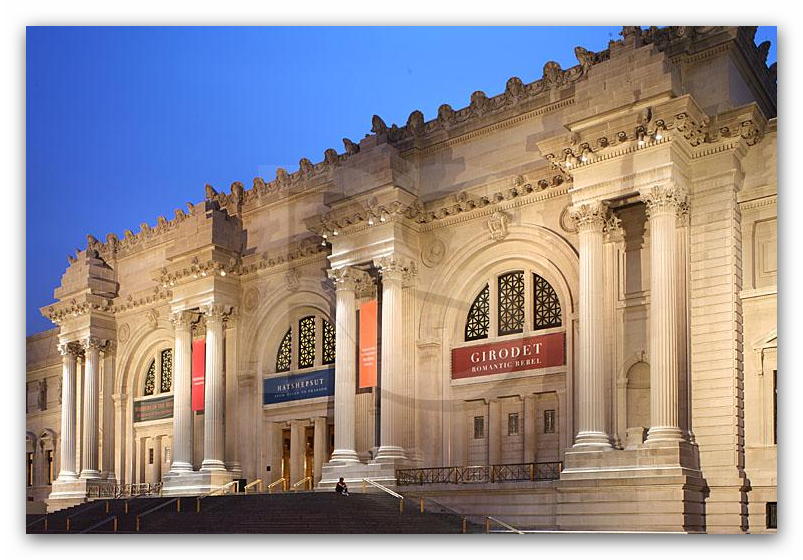
For a century and a half, the Metropolitan Museum has been building a world-class collection of art and artifacts from around the world, across time. Seventeen curatorial departments study, exhibit, and care for the objects in the Museum's collection.
One of the world's largest art museums, includes American art and decorative arts, European, African, Asian, Ancient Egyptian, Roman and Greek art, Byzantine and Islamic art, and modern art. The Museum's comprehensive collection of medieval and Byzantine art is displayed in both the Main Building and in the northern Manhattan satellite location, The Cloisters museum and gardens.
The Museum mounts dozens of special, temporary exhibitions. It was the Met that invented the "blockbuster" exhibition.
Please check the museum website for updated exhibition information. Scheduling has been reworked as a result of the temporary museum closure.
Exhibitions & Dates
Afterlives: Contemporary Art in the Byzantine Crypt
- Jan 10 2027
Trans-historical presentation of art that reckons with death and visualizes the afterlife
Flip Sides: Seeing Korean Art Anew
- May 31 2027
Multiple views of the inside, reverse, or hard-to-see aspects of objects.
Celebrating the Year of the Horse
- Jan 26 2027
The Horse, a creature symbolizing power, strength, and vitality.
The Infinite Artistry of Japanese Ceramics
- Aug 8 2027
Ceramics in dialogue with related art forms
Costume Art
May 10 2026 - Jan 10 2027
Presents connections between garments and artworks
The Face of Life: - Modern Portraits at The Met
May 18 2026 -
80 works explore portraiture from about 1900 to the 1960s
A King’s Carpet: Louis XIV and the Savonnerie
Sep 8 2026 - Mar 5 2028
Four complete carpets along with a selection of fragments
The Genesis Facade Commission: Liu Wei
Sep 17 2026 - Jun 8 2027
Four large-scale sculptures invite contemplation, surprise, and revelation
Krasner and Pollock: Past Continuous
Oct 4 2026 - Jan 31 2027
120+ works trace parallel lives and practices
Orientalism: Between Fact and Fantasy
Jun 12 2026 - Feb 28 2027
180+/- objects explore notions of “the East” in the 19th century
Cottage Industry: The Val-Kill Furniture Shop
Jul 18 2026 - May 9 2027
Celebrates Val-Kill, led by women and shaped by immigrant and rural craftspeople
City of Memory: Nanjing in the Seventeenth Century
Jun 27 2026 - Jan 3 2027
100+/- objects illuminate the evolution of Nanjing painting from the 1640s to the 1680s