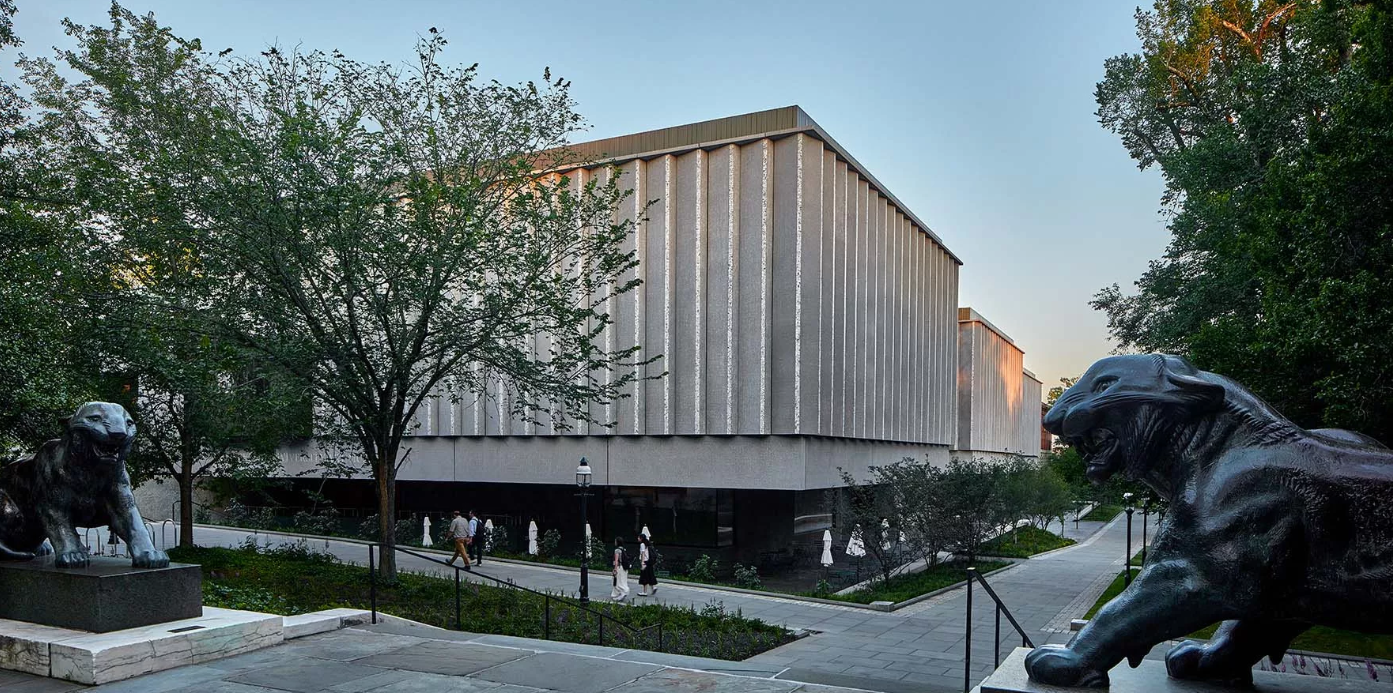
In the Fall of 2025, the Princeton University Art Museum opened in a new building, doubling the space for the exhibition, conservation, study, and interpretation of the Museum’s globe-spanning collections; for mounting temporary exhibitions; and for a new range of social gathering spaces and visitor amenities, including a restaurant. The existing Marquand Library was preserved and incorporated into the new Museum’s design but given a new stone facade, integrating it into the new facility, as well as new systems to allow for the care of its special collections. The facility is also home to the University’s Department of Art and Archaeology; together, the three units continue to function as a dynamic center for research and teaching, as they have since 1890.
With a collecting history that extends back to the 1750s, the Museum is one of the oldest collecting institutions in America, and the one of few university art museums of truly universal scope. Its collections, which number more than 92,000 works in all media, range from ancient to contemporary and span the globe.
Bequests by alumni over the course of more than two centuries has created a collection of extraordinary depth and breadth. In the 1930s alone, in addition to significant gifts of Chinese and Japanese art, several thousand objects, including significant holdings of prints and drawings, were bequeathed to the Museum by a member of the Class of 1888; more than 40 Italian paintings were given by a 1910 graduate, from his family’s villa in Fiesole; and a collection of more than 500 snuff bottles — still regarded as one of the finest early collections of the sort -- was willed by a 1903 graduate.
The outdoor sculpture collection includes works by Alexander Calder, Henry Moore, Louise Nevelson, Isamu Noguchi, David Smith, and Tony Smith.
Read our article in the Art Things Considered blog about how the PUAM collection -- described in 1922 as “the oddest kingdom of shreds and patches imaginable” -- became one of the nation’s foremost art museums.
Exhibitions & Dates
Clay Has Memory: Creative Lineages from Africa
Jul 19 2026 - Jul 3 2027
Artists use clay to sustain creative legacies from Africa
"What is an American?": Artists Reflect
May 16 2026 - Nov 8 2026
Works on paper that grapple with questions of American identity.
What Photographs Look Like
Jun 13 2026 - Dec 6 2026
Explores the nature of the medium, from photographic drawings to malleable photo-sculptures.
Joyce J. Scott: Declarations
Aug 15 2026 - Jan 10 2027
Intricate sculptural beadwork, often combined with glass, quilting, and found objects